As eye care professionals, we are tasked with managing a massive amount of information in our roles. Whether you are an OD, an MD, a Tech, or even an admin. From common to rare conditions, symptoms, treatments, diagnostic tools and methods, and every code and change it’s gone through. It’s no wonder we often get a little stuck in our lane.
Once we’re out of school and we’ve found our bearings, our practices will likely have their “focus”, and we tend to keep the information most relevant to us close and allow those things we know we knew at some point to sit in a dusty recess of our minds.
That’s why it’s often difficult to adopt new technology or transition from one system to another, and it can be even harder to incorporate a new revenue stream into your practice.
We want to make it easier to incorporate VRVF technology into your practice and make the most of all the tools the VF2000 offers.
The Test Types
Screening tests are the bread and butter of many eye care practices. Screenings typically consist of a suprathreshold and the easiest way to simplify this for your patient is letting them know that it’s a fairly quick and easy test where the device will present points of light that are bright enough that a healthy eye could see them. There are several different patterns, and while I personally am not a fan of suprathreshold tests (I like my sensitivity and specificity), there are functional tests like the Esterman that have a long history of being used to determine whether a patient’s vision is adequate for driving a motor vehicle.
On a small tangent, I mentioned I am not a fan of suprathreshold tests, but I am a big fan of fast screening protocols,s and I find the best middle ground is the FDT that brings speed and quantitative data to the tablet and is also available as an optional add-on module for the VF2000.
Threshold tests are where we get into the details with SAP (Static Automated Perimetry). There are myriad patterns, and on the VF2000, you have four different strategies. Without specifying the pattern, the simple explanation for your patient will be that the test will show them points of light in different places and at different brightness levels to see how much and how little they see at each point. If you are running the Full threshold strategy then I like letting them know it will feel long because it tests every point at every brightness while fast strategies look at other people their age that are tested and determine what a healthy patient would see and test around those brightness levels to speed things up while still showing them a few brighter and less bright points to make sure it gets the best information about what they see.
The VF2000 includes 9 threshold type patterns, including the most common (24-2, 10-2) to less common but extremely useful Optic Nerve Test and Amsler Grid. While most patients won’t ask, we occasionally do get the questions so to explain it in simple terms for the patient, you can say the number in the front tell you how far from the center we’re testing and the number after the dash (-1 vs -2) will tell you if the points start on the pattern axis lines or on either side of them.
On another tangent, the Optic nerve test may be particularly useful now that GLP-1 medications are so prolific. Our medical director, Rafi Israel, M.D,. recently recalled a study he workedon (over 20 yrs ago!) on looking at the correlation between optic nerve size and NAION.
Ptosis Tests
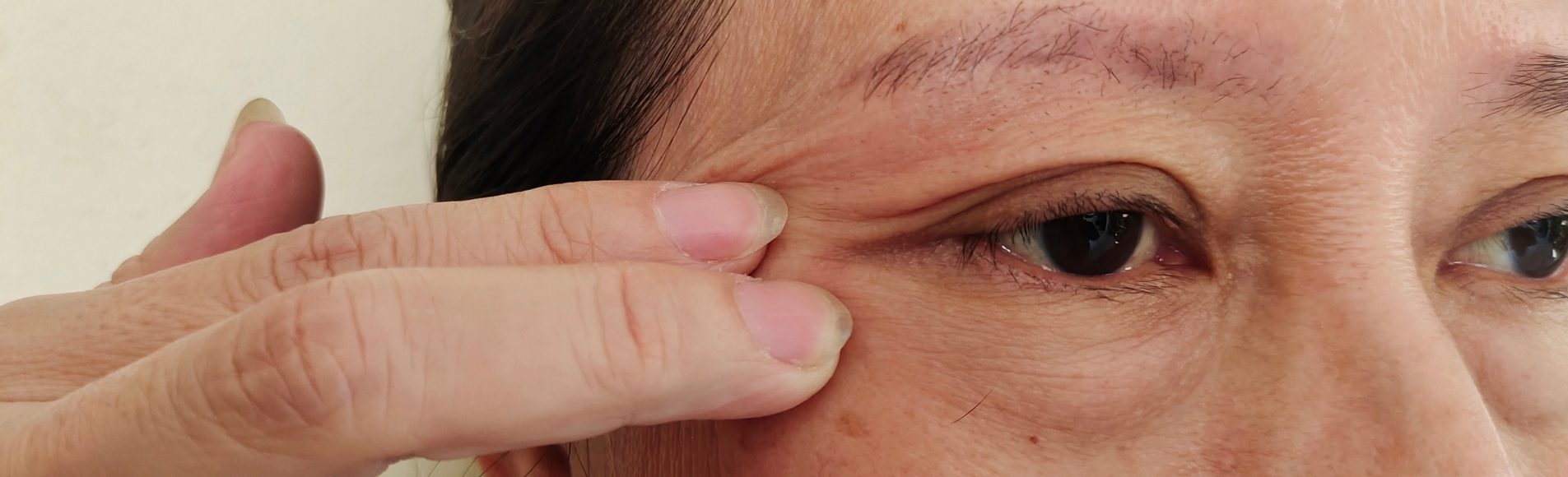
Ptosis tests will focus on the superior points, as the goal is to determine how much a patient’s lid or brow drooping is affecting their superior field of vision. The tests are suprathreshold type tests, like the screening, so they present a single intensity stimulus.
Since these tests are typically done to determine the degree to which the field of vision is limited, the patient may already be aware of why the test is being done, but they may not be familiar with the process. I usually explain to patients that as the lid droops, it may block their vision and to check if it does and how bad it is, we’ll take a visual field with them just looking at the fixation and another test where we’ll tape the lid up and they look at the same fixation and if there’s a big difference between how much they see then the doctor will discuss some options with them.
There are 5 Ptosis patterns in the Ptosis test type section, which are SAP, but there are also 2 additional Ptosis patterns in the Kinetic/Ptosis section that are Kinetic tests, which have a moving stimulus, and the patient is instructed to respond once they see the stimulus enter their field of vision.
Choosing which Ptosis or Kinetic Ptosis pattern to use will depend on the doctor’s preference, and whether it will be submitted for insurance approval for blepharoplasty, then it’s best to check what pattern the carrier will accept.
Neuro Tests
Neuro tests are limited to 3 patterns: Neuro 20, Neuro 35, and Full Field 120-point. It’s fair to say that any visual field can show signs that can help determine if the loss of sensitivity is neurological in its origin. The Neuro 20 (16 points, 20 degrees eccentricity) and Neuro 35 (32 points at 35 degrees of eccentricity) tests are designed to be shorter by limiting the points, as we are looking for vision loss in sectors and not specific points, and the Full Field test will present 120 points out to 65 degrees. Here’s a reference to an excellent article from ASCO for Differentiating Intracranial Pathology Using Visual Fields, and I particularly recommend the diagram they feature.
Kinetic and Kinetic Ptosis Tests
Last but not least, Kinetic/Ptosis tests were briefly introduced when we spoke about Ptosis. Aside from the Kinetic Ptosis test, there are 3 additional patterns.
As mentioned before, these are single-intensity stimulus tests where the stimulus does not appear and disappear in a static position. In Kinetic tests, the stimulus is presented at or outside the patients’ field of view and travels along predetermined meridians toward the central fixation point.
The patient is instructed to press the trigger once they see the stimulus enter their field of view. These tests are also known as Goldmann type, and ours map the outside hill of vision. The Kinetic 60-16 pattern is most commonly known as it is used by the VA and contract providers for their C&P or Compensation and Pension tests.
There’s also a test called AFVF that was added at the request of one of our users. This is a Kinetic test where 8 meridians are used, and the stimulus is presented in red, green, blue, and white. The patient must respond by indicating when the stimulus enters their field of view and which color they perceive. If the color selection is incorrect, they must attempt again. We’ve heard positive feedback from optometrists and ophthalmologists specializing in vision therapy, neuro ophthalmology, and behavioral ophthalmology.
Exploring More With VF2000
We hope this helps our users explore some tests they don’t usually use, and we love hearing customer feedback; are there any tests you haven’t explored and want to know more about? Don’t hesitate to contact Micro Medical Devices at support@micromedinc.com with any questions.