Delivering comprehensive cataract care in nursing homes presents unique challenges. Many residents have limited mobility, cognitive decline, or difficulty cooperating with traditional diagnostic procedures. These limitations make it difficult for clinicians to perform essential tests such as visual field assessments, biometry, and Pachymetry, often leading to underdiagnosis or delayed treatment.
The emergence of virtual reality visual field (VRVF) technology is transforming how eye care professionals manage cataract patients in long-term care settings. Portable, accurate, and patient-friendly, virtual field systems from companies such as Micro Medical Devices are bridging the gap between clinical precision and accessibility, ensuring that even the most vulnerable populations receive high-quality vision care.
1. The Growing Need for On-Site Cataract Care in Nursing Homes
As the population ages, the prevalence of cataracts and comorbid conditions such as glaucoma and macular degeneration continues to increase. Nursing home residents face additional barriers including limited access to diagnostic clinics, physical challenges such as wheelchair dependence, cognitive impairments that hinder cooperation, and transportation limitations for follow-up appointments.
Comprehensive cataract management in nursing homes requires portable diagnostic solutions that adapt to the patient rather than forcing the patient to adapt to the equipment.
2. Challenges with Traditional Visual Field Testing
Traditional bowl perimetry devices are accurate but impractical in long-term care environments. They require a darkened room, precise head positioning, extended fixation, and clear patient understanding of the process. For elderly or cognitively impaired residents, these demands are often unrealistic, resulting in incomplete tests and missed diagnoses.
3. How Virtual Visual Field Testing Solves Accessibility Challenges
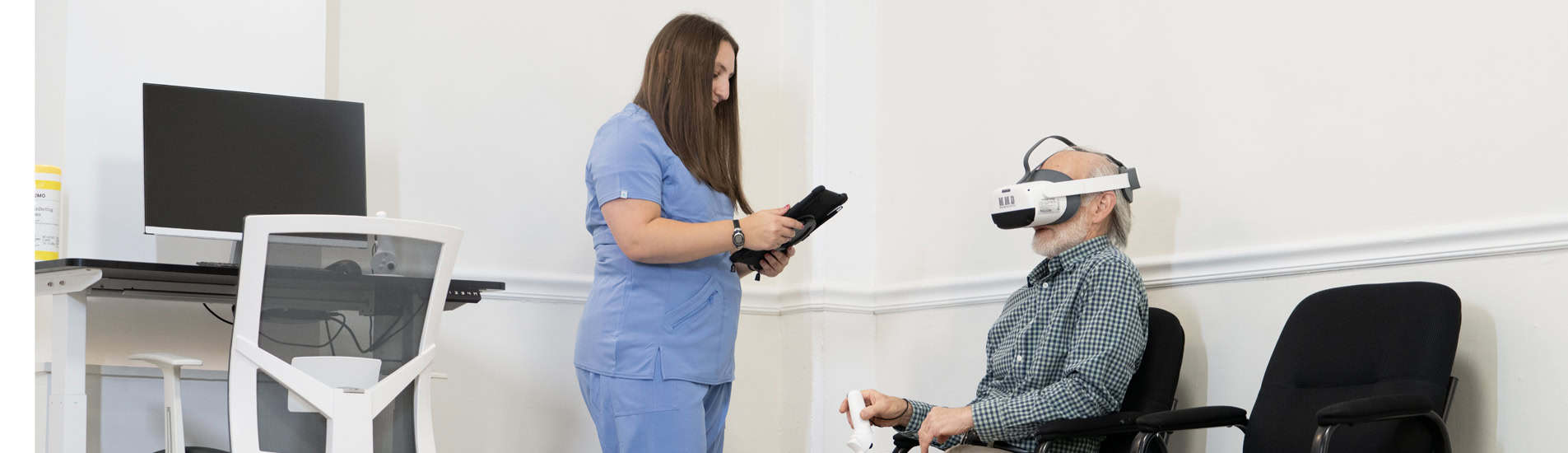
Virtual reality visual field devices, such as Virtual Field, are headset-based systems designed for portable, flexible testing in nursing homes and assisted care facilities.
Advantages for Nursing Home Settings
Portable and lightweight for bedside or wheelchair-based testing
No dark room required due to built-in light control
Comfortable and non-intimidating design
Faster testing, often under five minutes per eye
Greater engagement through the vision virtual reality interface
Objective accuracy supported by gaze tracking
Virtual reality perimetry makes functional testing possible in environments where traditional perimetry cannot be performed.
4. Integrating Virtual Field Testing Into Cataract Evaluation
Cataract evaluation is not limited to assessing lens opacity. It requires understanding total visual function. Virtual visual field testing distinguishes cataract-related blur from other visual impairments such as glaucoma.
Pre-Surgical Benefits
Establishes baseline functional data
Identifies hidden conditions masked by cataracts
Improves counseling on expected outcomes
Post-Surgical Benefits
Confirms improvement in functional vision
Identifies any remaining field defects
Monitors for postoperative complications
Virtual perimetry supports clinical documentation and is billable under standard visual field CPT codes.
5. Complementary Diagnostic Tools for Comprehensive Cataract Management
For a complete evaluation, virtual field testing should be combined with additional portable diagnostics.
Key Tools and Their Roles
Biometry / A-Scan
Measures axial length for IOL calculations
Portable for bedside pre-op assessment
B-Scan Imaging
Visualizes posterior structures when cataracts obscure the view
Detects retinal detachments or hemorrhages
Pachymetry
Measures corneal thickness for IOP correction
Fast, portable, and ideal for glaucoma management
Keratometer
Determines corneal curvature
Essential for astigmatism correction and lens planning
CXL (Corneal Crosslinking)
Stabilizes corneal structure for keratoconus
Ensures corneal integrity before and after cataract surgery
When combined with virtual visual field technology, these diagnostics enable comprehensive, data-driven cataract management without requiring travel to outside clinics.
6. Overcoming Cognitive and Physical Limitations
Elderly patients with dementia or limited physical ability often struggle with long or complex testing. Virtual perimetry simplifies the process through shorter tests, flexible seating or reclining options, intuitive visual prompts, and automatic reliability scoring. Clinicians report far fewer incomplete tests compared to traditional perimetry.
Virtual reality perimetry opens the door to meaningful assessments for patients who were previously unable to be tested at all.
7. Workflow Integration for Mobile and On-Site Eye Care Teams
Mobile eye care providers can easily incorporate virtual field testing into a nursing home workflow.
Typical Workflow
Initial screening with VR perimetry, biometry, and Pachymetry
Remote review of results through cloud-based integration
Development of treatment plans or surgical candidacy decisions
Follow-up testing after cataract extraction using virtual perimetry
This model reduces travel costs, increases efficiency, and provides Medicare-compliant documentation for billing and audits.
8. Enhancing Compliance and Documentation
Payers increasingly require objective evidence of medical necessity. Virtual reality perimetry simplifies compliance by generating detailed, timestamped reports with fixation scores, reliability indices, diagnostic summaries, and EMR-compatible exports.
When combined with biometry, B-Scan, and Pachymetry data, this creates a complete record that is both clinically useful and audit-ready.
9. Benefits for Providers and Facilities
For Eye Care Providers
Greater access to homebound patients
Faster workflows with reliable documentation
Reduced equipment footprint
Increased billable diagnostic volume
For Nursing Homes
Better resident care and satisfaction
Reduced need for external referrals
Improved compliance with preventive care standards
Virtual visual field technology transforms cataract management from reactive to proactive.
10. Looking Ahead: The Future of Eye Care in Long-Term Facilities
The future of geriatric eye care lies in portable diagnostics, AI integration, and virtual care ecosystems. Next-generation systems will combine VR perimetry, biometry, Pachymetry, and B-Scan imaging into a unified diagnostic hub that syncs with cloud-based EMRs.
Emerging Trends
AI-driven risk analysis for cataract and glaucoma overlap
Tele-ophthalmology consultations through cloud-connected devices
Wearable vision tracking for remote patient monitoring
For nursing home residents, this means earlier detection, consistent monitoring, and improved quality of life without leaving their environment.
Conclusion
Cataract management in nursing homes presents unique barriers, but virtual reality visual field technology is redefining what is possible. By enabling accurate, comfortable, and portable testing, virtual field systems supported by Micro Medical Devices help clinicians deliver high-quality, accessible care.
When integrated with biometry, Pachymetry, B-Scan imaging, Keratometer readings, and CXL, these solutions form the foundation of a comprehensive mobile cataract care system that respects patient limitations while meeting the highest standards of diagnostic accuracy.
Virtual perimetry is not only a technological advancement; it is a compassionate innovation that brings quality eye care directly to those who need it most.
Ready to Improve Cataract Management in Long-Term Care Facilities? Call us today at 818-222-3310.