For decades, tabletop perimetry has been the gold standard in visual field testing. However, advancements in virtual reality visual field (VRVF) technology have redefined what is possible in both diagnostic accuracy and patient comfort.
As practices look to optimize space, efficiency, and ROI, the VF2000 by Micro Medical Devices is challenging the traditional model and transforming how eye care professionals approach functional testing.
This guide explores the differences, benefits, and considerations between virtual visual field systems and conventional tabletop perimeters, offering a clear picture of what is next for modern eye care.
It is not just evolution. It is a revolution in how visual function is measured and experienced.
1. The Problem with the Status Quo
Conventional tabletop perimeters such as Humphrey and Octopus have long served as clinical staples. Yet, as eye care becomes more fast-paced and patient-centered, its limitations are harder to ignore.
Common Challenges of Traditional Perimetry
Large footprint requiring dedicated dark rooms
Long testing times, often 10 to 12 minutes per eye
Uncomfortable chin rests and rigid positioning
High fixation loss due to fatigue
Ongoing maintenance, bulb replacement, and calibration
For small clinics and mobile providers, these limitations restrict workflow efficiency and scalability.
What worked 20 years ago is no longer enough for today’s high-efficiency practices.
2. The Rise of Virtual Reality Visual Field Testing
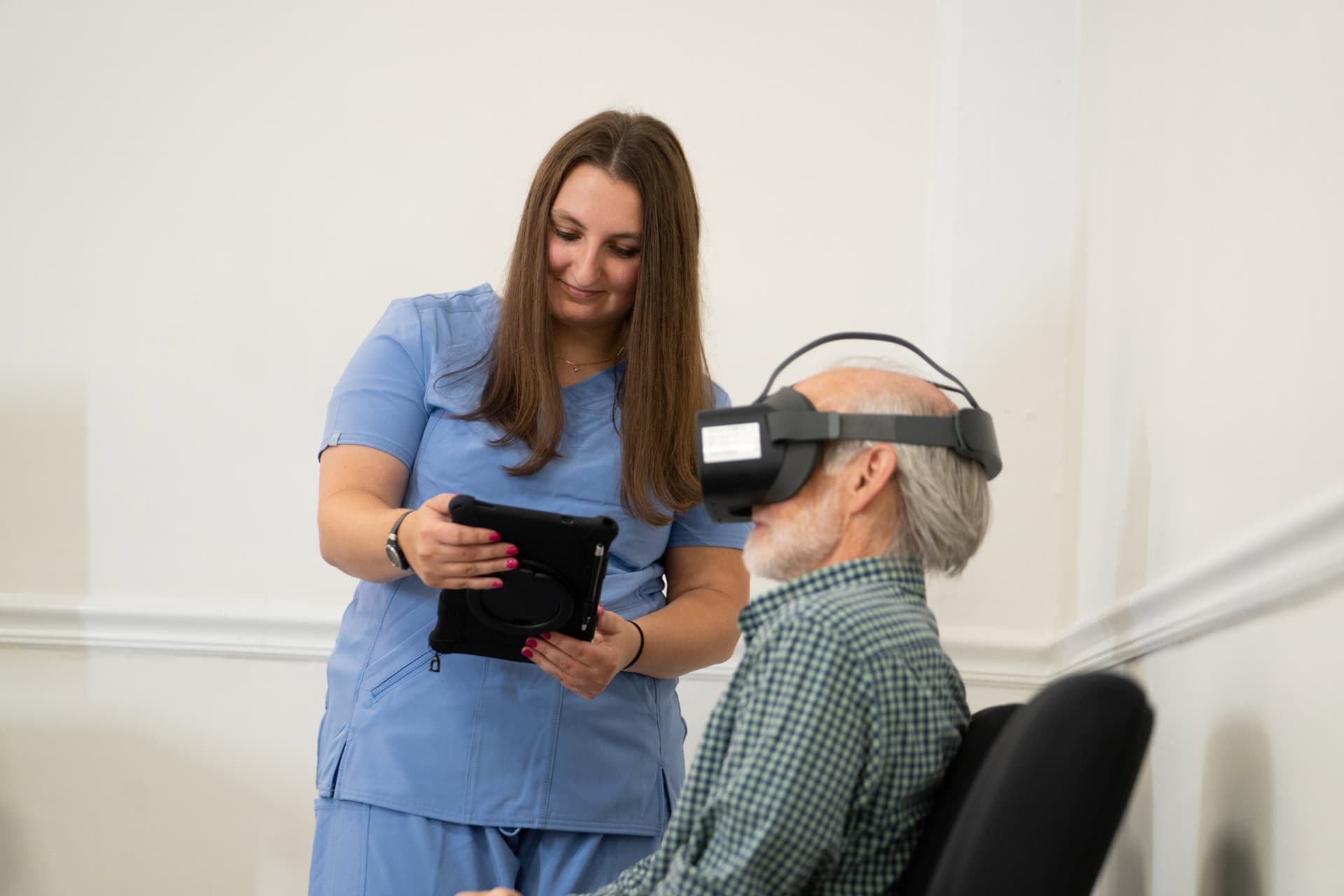
Enter the VF2000 by Micro Medical Devices, a VR-based perimetry system that delivers an immersive, accurate testing environment. Patients wear a lightweight headset that replicates traditional perimetry through vision VR technology in a portable, comfortable, and data-rich format.
Core Advantages
Portability: Perform exams anywhere without a dark room
Speed: Full threshold testing in 3 to 5 minutes per eye
Accuracy: Real-time gaze tracking ensures reliable data
Comfort: VR environment reduces anxiety and fatigue
Integration: EMR compatible with CPT-coded outputs
The VF2000 maintains the precision of tabletop perimetry while elevating accessibility and workflow efficiency.
3. Comparing the VF2000 vs. Tabletop Perimetry
| Feature | Traditional Tabletop Perimeter | Virtual Visual Field (VR Perimetry) |
|---|---|---|
| Setup and Space | Requires a large dedicated room | Compact, portable headset |
| Testing Time | 8 to 12 minutes per eye | 3 to 5 minutes per eye |
| Patient Comfort | Chin rest, fixed posture | Comfortable, natural seating |
| Mobility | Clinic bound | Fully portable |
| Reliability | High but fatigue dependent | AI-enhanced fixation tracking |
| Maintenance | Frequent calibration | Minimal upkeep |
| Integration | Manual transfers | Cloud-based EMR sync |
The VF2000 simplifies everything from setup to documentation, allowing more focus on clinical care.
4. Clinical Accuracy and Validation
A common clinician question is:
Can the VF2000 testing match traditional perimetry?
Multiple studies confirm that VR perimetry, including the VF2000, strongly correlates with Humphrey data across MD, PSD, and pattern deviation values.
Clinical Reliability Factors
Gaze tracking ensures fixation
Randomized stimuli replicate standard strategies
AI evaluates false positives, false negatives, and reliability indices
The VF2000 meets and often exceeds tabletop accuracy while eliminating physical barriers to testing.
5. The Patient Experience: A Game Changer
Traditional perimetry can feel intimidating or uncomfortable for elderly, anxious, pediatric, or post-surgical patients.
What Patients Say About the VF2000
“It feels natural and not stressful.”
“It is faster and easier to stay focused.”
“I am not exhausted afterward.”
The immersive VR environment improves focus, reduces anxiety, and enhances data quality.
When patients feel comfortable, diagnostic confidence goes up.
6. Workflow Efficiency and Practice ROI
For practice owners, time and space directly impact profitability.
The VF2000 Delivers ROI By
Reducing test time per patient
Allowing multiple exams with a single technician
Eliminating dedicated perimetry rooms
Producing CPT billable exams under 92081 to 92083
Lowering equipment maintenance costs
Virtual perimetry transforms visual field testing into a fast, scalable, revenue-positive workflow.
7. Integration with Other Diagnostic Systems
The VF2000 integrates seamlessly with core ophthalmic diagnostics. Combined, they create a complete structural and functional picture.
| Tool | Function | How It Complements the VF2000 |
|---|---|---|
| Biometry / A Scan | Axial length | Correlates ocular length with field loss |
| Pachymetry | Corneal thickness | Supports glaucoma management |
| B Scan | Posterior imaging | Validates causes of field defects |
| Keratometer | Corneal curvature | Identifies refractive contributors to defects |
| CXL | Corneal stabilization | Monitors functional change before and after treatment |
Together, these tools create a 360-degree insight into visual function and ocular pathology.
8. Accessibility and Mobility: Eye Care Without Boundaries
Traditional perimeters restrict testing to the clinic. the VF2000 takes diagnostics anywhere.
Ideal Use Cases
Rural and mobile eye care programs
Nursing homes and assisted living
School screenings
Postoperative home evaluations
Multi-location ophthalmology groups
With VR perimetry, advanced diagnostics meet patients where they are.
9. Simplifying Training and Staff Utilization
The VF2000 was designed to be technician-friendly.
Staff Benefits
Learn in under 30 minutes
Automated test sequences
Voice-guided instructions
EMR-ready results
Allows multitasking during busy clinic hours
Less training, more productivity, higher ROI.
10. The Future of Visual Field Testing
VR visual field systems continue to accelerate across eye care. With new advancements powered by Micro Medical Devices, the future is even more exciting.
Coming Innovations
AI-based glaucoma prediction
Home-based teleperimetry
Automated OCT and B-Scan data fusion
Unified functional structural diagnostic platforms
The status quo is shifting. The VF2000 is leading the transformation.
Conclusion
The debate between virtual visual fields and traditional tabletop perimetry is not about discarding the old. It is about recognizing what improves the future. The VF2000 by Micro Medical Devices delivers precision, portability, patient comfort, and operational efficiency in one powerful solution.
When combined with diagnostics such as biometry, Pachymetry, B Scan, and CXL, the VF2000 allows clinicians to deliver care that is both clinically advanced and patient-centered.
Ready to modernize your visual field testing workflow? Contact us today to learn how the VF2000 by Micro Medical Devices can improve accuracy, efficiency, and patient experience in your practice.