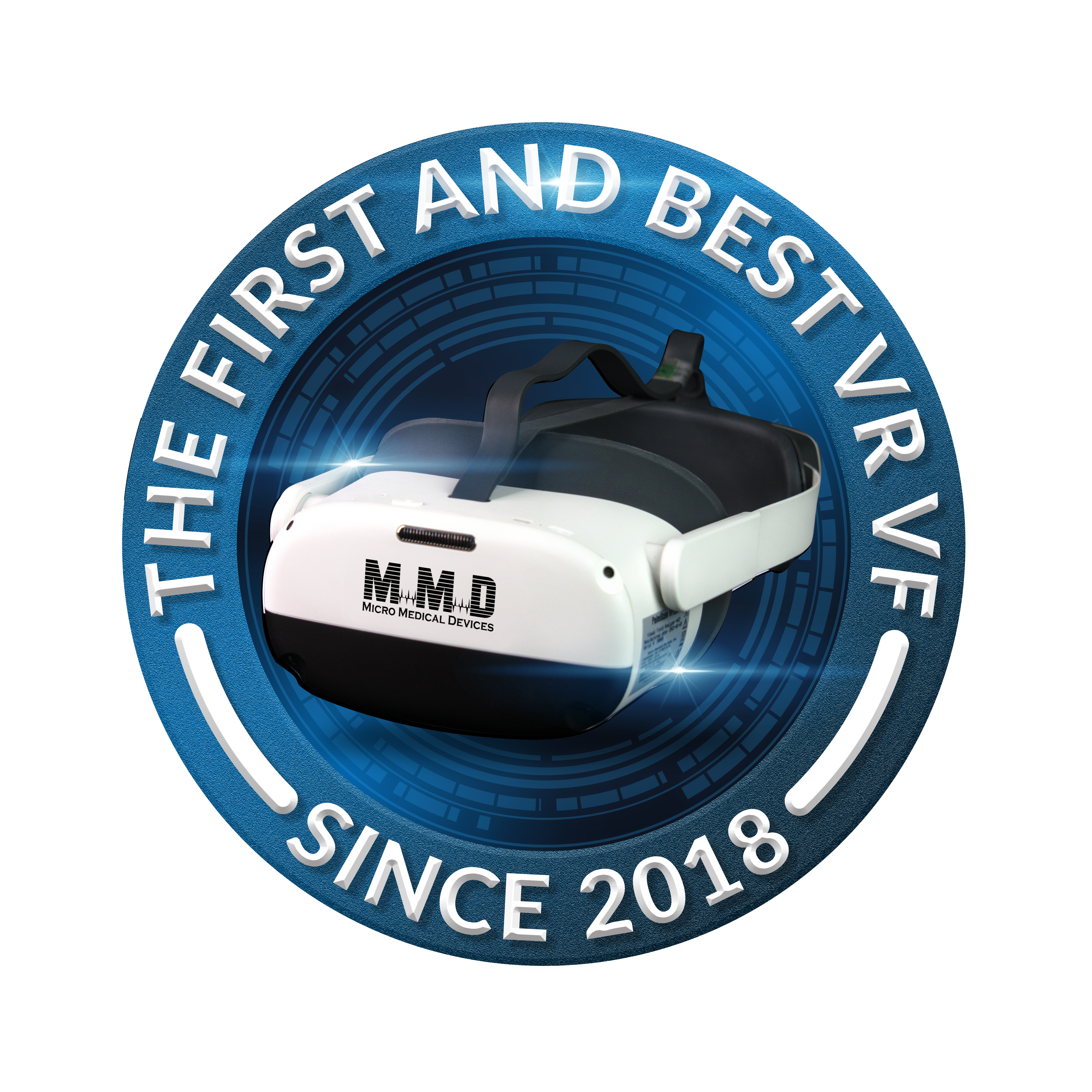

The evolution of visual field testing has entered a new era, one defined by portability, precision, and patient comfort. Among the leaders driving this transformation is Virtual Field, a breakthrough in virtual reality visual field (VRVF) technology that brings clinical-grade accuracy to a lightweight, accessible headset.
As ophthalmology embraces digital innovation, evaluating the accuracy and clinical effectiveness of Virtual Field’s virtual perimetry (VR perimetry) is essential. Clinical evidence and real-world use show that Virtual Field not only matches traditional tabletop perimeters but, in many cases, improves workflow efficiency and patient compliance.
1. The Shift from Traditional to Virtual Visual Field Testing
For decades, visual field testing has relied on bulky tabletop devices such as the Humphrey Field Analyzer. While reliable, these systems require dark rooms, chin rests, and extended test times that can lead to patient fatigue and inconsistent results.
Virtual Field reimagines this process using vision virtual reality technology that replicates standard perimetry in a portable, headset-based format.
Key advantages include:
- Portable and wireless testing
- Full 24-2C testing in under five minutes per eye
- No dark room or eye patch required
- AI-driven fixation tracking
- Cloud-based reporting and EMR integration
Virtual perimetry delivers comparable precision without the physical limitations of traditional devices.
2. Validating Clinical Accuracy: Virtual Field vs Traditional Perimetry
Clinical validation studies comparing Virtual Field to standard automated perimetry demonstrate strong equivalence across key metrics.
Validation findings include:
- Comparable Mean Deviation (MD) and Pattern Standard Deviation (PSD) values
- Fixation loss and false-positive rates within accepted clinical limits
- High inter-test repeatability
These results confirm that Virtual Field delivers clinical-grade accuracy while offering greater flexibility.
3. Patient Comfort and Compliance as Accuracy Drivers
Accuracy depends heavily on patient comfort. Traditional bowl perimeters can cause fatigue, anxiety, and poor fixation, particularly in elderly or mobility-limited patients.
Virtual Field’s ergonomic headset allows testing in a seated or reclining position, improving:
- Fixation stability
- Test completion rates
- Reproducibility across follow-up visits
Comfort directly improves data quality and clinical confidence.
4. AI-Driven Reliability and Quality Control
Artificial intelligence plays a central role in Virtual Field’s performance. Built-in algorithms continuously analyze fixation, response timing, and reliability indices.
AI-supported features include:
- Real-time fixation monitoring
- False response detection
- Automated quality scoring
- Longitudinal progression analysis
AI ensures consistent, objective test validation across every exam.
5. Clinical Applications Across Ophthalmology
Virtual Field supports a wide range of ophthalmic conditions:
| Condition | Role of Virtual Field | Test Pattern |
|---|---|---|
| Glaucoma | Early detection and progression monitoring | 24-2 / 24-2C |
| Plaquenil toxicity | Paracentral macular monitoring | 10-2 |
| Neuro-ophthalmic disease | Pathway integrity assessment | 30-2 / custom |
| Post-CXL or cataract surgery | Functional recovery tracking | Fast threshold |
| Retinal disease | Functional-structural correlation | 24-2 / 30-2 |
Virtual Field’s versatility supports comprehensive clinical decision-making.
6. Integrating Virtual Field with Structural Diagnostics
The most accurate ophthalmic assessments combine functional and structural data. Virtual Field integrates seamlessly with diagnostic tools from Micro Medical Devices, supporting a complete diagnostic ecosystem.
Integrated tools include:
- A-Scan biometry for axial length measurement
- Pachymetry for corneal thickness evaluation
- Keratometry for corneal curvature assessment
- B-Scan ultrasound for retinal and optic nerve imaging
- CXL-related diagnostics for post-procedure monitoring
Micro Medical Devices provides a precise anatomical context that strengthens the interpretation of visual field results and improves diagnostic confidence.
7. Workflow Efficiency and Practice Impact
Virtual Field improves operational efficiency by reducing setup time and increasing patient throughput.
Efficiency benefits include:
- No dedicated testing room required
- Faster per-eye test completion
- Immediate cloud access to results
- Ideal for multi-location and mobile practices
Time saved allows clinicians to focus more on patient care.
8. Portability and Expanded Access to Care
Virtual Field enables accurate visual field testing in:
- Nursing homes and senior living facilities
- Community screening programs
- Mobile outreach clinics
- Tele-ophthalmology workflows
This portability supports earlier detection and improved compliance in underserved populations.
9. Clinical Outcomes and Provider Feedback
Clinicians consistently report:
- Diagnostic outcomes comparable to HFA and Octopus systems
- Improved patient satisfaction
- Greater testing success in pediatric, geriatric, and disabled patients
Real-world use reinforces the findings of clinical validation.
10. The Future of Functional Vision Testing
Virtual Field continues to advance through research and innovation, with future developments including:
- AI-driven progression alerts
- Remote testing integration
- Expanded multilingual audio support
- Deeper EMR and imaging system integration
The future of perimetry is intelligent, connected, and patient-centered.
Conclusion
Virtual Field has proven to be a clinically accurate and effective alternative to traditional tabletop perimetry. By combining virtual reality visual field testing, AI-powered analytics, and integration with Micro Medical Devices diagnostics such as biometry, Pachymetry, B-Scan, Keratometer, and CXL tools, clinicians gain a comprehensive approach to vision care.
Virtual Field represents the next generation of functional testing in ophthalmology, delivering precision without compromise.
Experience the future of visual field testing.
Learn how Virtual Field and Micro Medical Devices work together to deliver accurate diagnostics, efficient workflows, and superior patient outcomes.
Contact us today to see how this integrated approach can elevate your ophthalmology practice.